
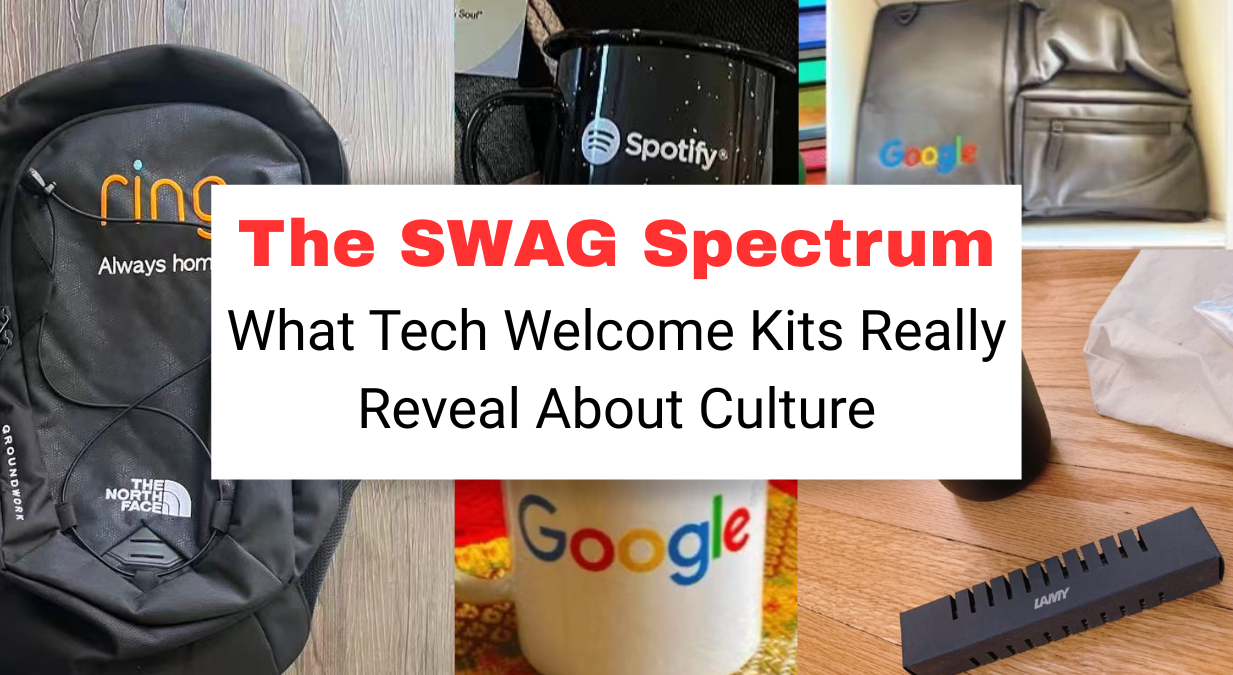
The SWAG Spectrum: What Welcome Kits from Google, Apple, and Shopify Reveal About Tech’s Deeper Cultural Code
When you start a new job in tech, one of the most anticipated rituals is the “unboxing” of the new hire welcome kit. On the surface, it’s a box of free “SWAG” (Stuff We All Get). But look closer. This is no grab-bag of leftovers. It is a meticulously crafted cultural handshake, a company’s first and most tangible statement of its values, its expectations, and its very identity.
A backpack is not just a backpack. A coffee mug is not just a coffee mug.
After analyzing the welcome kits from six of the most influential tech companies—Google, Meta, Apple, Notion, Shopify, and Amazon Ring—a clear pattern emerges. SWAG doesn’t just exist; it operates on a spectrum of strategic intent. It evolves from a simple tool for belonging to a sophisticated mechanism for product integration.
Here is a breakdown of the four levels of tech SWAG.
Level 1: The Standard Kit (Utility & Belonging)
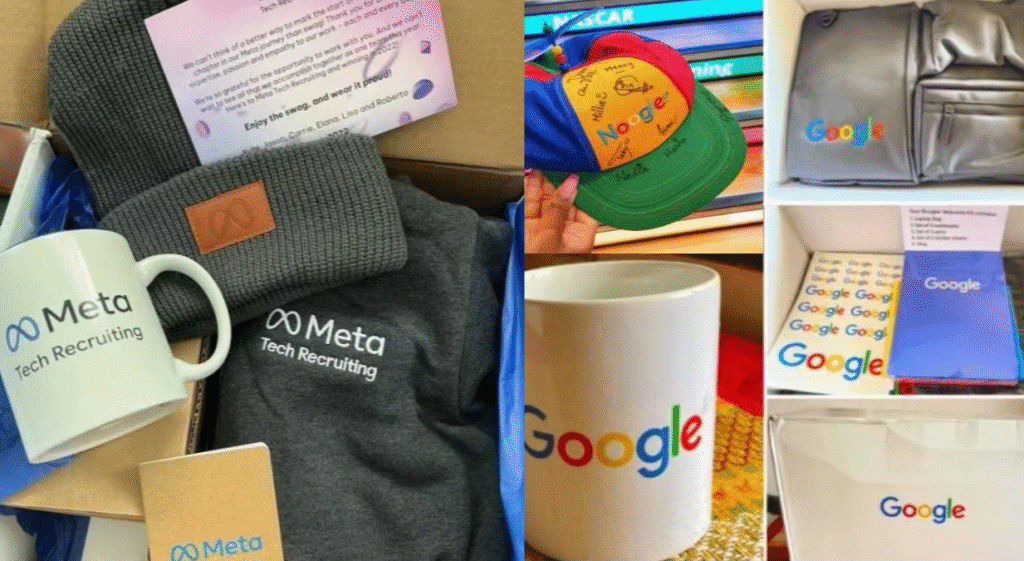
This is the baseline for all large-scale tech companies. The goal is simple: make thousands of new hires feel like part of the tribe, instantly and efficiently.
- Case Studies: Google & Meta
- Key Items: Branded backpack, ceramic mug, notebook, pens, t-shirt/jumper, stickers.
These items are the “tech uniform.” They are practical, useful, and above all, they create immediate brand identity. The moment a new employee uses their logoed backpack or wears the company jumper, they have transitioned from an individual to a team member.
The Strategy: This is about practicality and scale. The items are designed to be used every day, turning employees into walking billboards and fostering a “tribal” sense of belonging. It’s effective, efficient, and essential for global companies onboarding thousands.
Level 2: The Statement Kit (Aspiration & Values)
This is where SWAG gets interesting. Level 2 moves beyond simple utility to make a deliberate statement about the company’s taste, quality standards, and social values.
2a. The Eco-Statement
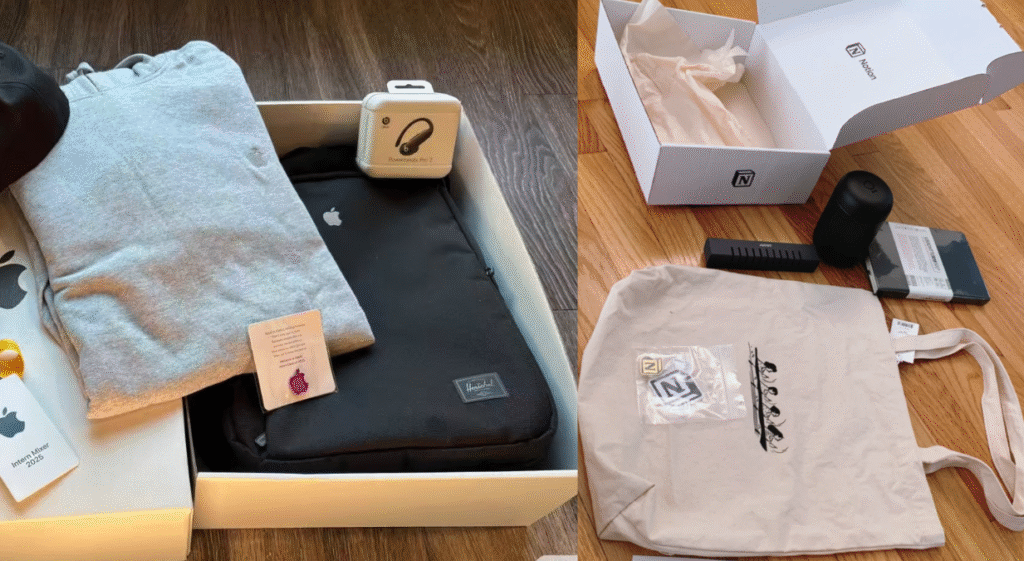
- Case Studies: Apple, Notion, Shopify
- Key Items: Apple’s stainless steel bottle, Notion’s Fellow bottle, Notion’s canvas bag, Shopify’s reusable cup.
When a company gives you a high-quality, reusable bottle, it’s doing more than just giving you a cup. It’s physically handing you its environmental policy. The message is clear: “We are a company that values design and sustainability, and now you are part of that. We don’t use disposable cups here.”
2b. The Premium Statement
- Case Studies: Amazon Ring, Notion
- Key Items: Amazon Ring’s The North Face backpack, Notion’s Lamy pen.
This is a power move. Ring doesn’t just give a backpack; it gives a co-branded North Face backpack. Notion doesn’t just give a pen; it gives a Lamy. The strategy here is aspiration through association. The message is: “You didn’t just join a company; you joined an elite company. We use the best, and now you do, too.” It aligns the employee with a brand that already signifies quality, durability, and status.
Level 3: The “Vibe” Kit (Cultural Alignment)
This is the most sophisticated level of brand-building. The SWAG is no longer just about the company; it’s about aligning the new employee with the spirit of its customers.
- Case Studies: Shopify, Notion
- Key Items: Shopify’s enamel mug & Urbanista headphones, Notion’s candle.
Shopify’s choice of an enamel mug is a stroke of genius. Google gives a ceramic mug (corporate). Apple gives a steel bottle (tech). An enamel mug evokes a different spirit entirely: “artisan,” “craft,” “indie coffee shop,” “maker.” It’s the cup of a creator. Shopify is aligning its employees with the very entrepreneurs and small business owners they serve. The Urbanista headphones reinforce this “urban creative” vibe.
Similarly, Notion’s candle isn’t just a smell. It’s a symbol of its “Calm Tech” brand—an environment of focus, design, and deep work. They are handing you their aesthetic and workflow in physical form.
The Strategy: This is deep cultural alignment. The SWAG says, “You are not just a tech worker. You are a creator, a maker, a focused individual—just like the customers you are here to support.”
Level 4: The Integration Kit (Product as Culture)
This is the final, most powerful level of SWAG strategy, where the lines blur completely. The SWAG is no longer about the company; it is the company.
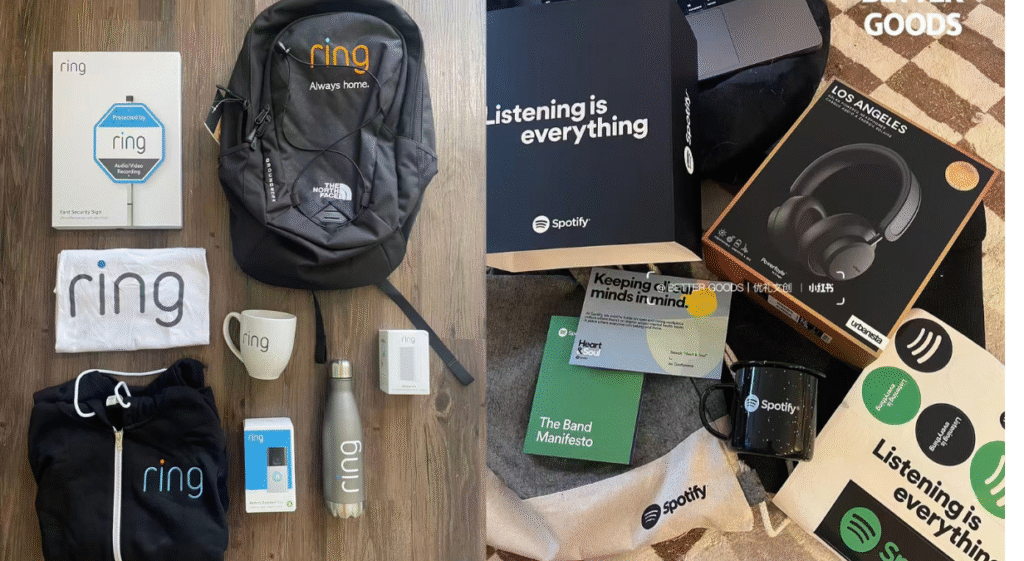
- Case Study: Amazon Ring
- Key Items: Battery Doorbell Plus, Yard Security Sign, Chime Pro.
By giving employees its own core products, Ring is executing a multi-layered strategy:
- Forced “Dogfooding”: (A term for “eating your own dog food”). The company forces its entire staff—from engineers to marketers—to become daily, real-world users of its products. An engineer will be the first to notice a lag in their own doorbell’s app. A marketing manager will be the first to realize the yard sign fades in the sun. This creates the most powerful, critical, and fastest feedback loop possible.
- Creating Evangelists: When an employee’s friends come over, they will naturally see and ask about the Ring doorbell. The employee becomes the most authentic brand evangelist possible, speaking from personal experience.
- Mission Reinforcement: Ring’s mission is to “make neighborhoods safer.” By giving employees the tools to make their own homes safer, the company transforms the mission from an abstract corporate slogan into a tangible, personal reality.
Conclusion: From Utility to Identity
SWAG is a calculated cultural investment. It’s a spectrum that runs from simple utility to deep ideological integration.
- Level 1 (Google) says: “Welcome to the team. Here are your tools.”
- Level 2 (Apple) says: “We are a premium, sustainable company. We expect you to be, too.”
- Level 3 (Shopify) says: “You are one of us. You have the spirit of a creator.”
- Level 4 (Amazon Ring) says: “You don’t just work on the product. You live the product.”
The next time you unbox a welcome kit, don’t just ask, “What did I get?”
Ask, “What are they telling me?”
If you’re inspired to build a SWAG program that aligns perfectly with your brand’s unique mission, request a quote to get started.